
Editor’s note: Sreekumar Somasundaram is a senior supply chain technical program manager at AWS. This article and its content was created prior to his current position with AWS.
One of the core capabilities of a warehouse management system (WMS) is its put-away engine. A put-away engine allows warehouses to model the business logic that determines where each product should be stored at the time it is received into the warehouse. Every WMS provides the ability to configure put-away rules, and during put-away execution, those rules are evaluated to determine the correct destination bin. When rules do not return a valid result, the system either presents an error or defaults to a fallback bin.
However, building and maintaining these put-away rules requires significant configuration effort. Even small changes demand extensive regression testing, because put-away rules are foundational to system-directed inbound operations. In high-volume environments, performance is also critical. Operators cannot wait for the system to determine storage locations; decisions must return in seconds. This makes put-away configuration both high-risk and high-effort.
With recent advancements in AI, this article explores whether AI and machine learning (ML) can simplify put-away configuration—either by reducing the complexity of put-away rules or by allowing AI to determine bin placement dynamically within defined storage boundaries. The article examines the challenges through two examples—put-away from inbound to storage in a build-to-order environment and put-away from inbound to outbound through opportunistic cross-docking.
Rather than proposing a definitive solution, this article explores whether recent advancements in AI and machine learning could offer an alternative way to think about bin-level decision-making within existing WMS constraints.
Challenges with current put-away configuration
Put-away rules must be fully configured during the WMS implementation. Testing these rules is labor-intensive, and post-go-live adjustments also require careful change control.
Example scenario
In a build-to-order scenario, a warehouse manager wants all products that share common outbound order attributes (for example, ship-to location and ship date) to be consolidated in the same bin to improve pick efficiency.
To achieve this, a put-away rule must:
- Identify outbound order attributes for the product being put away.
- Search for existing bins that contain products with matching attributes.
- Suggest that bin if conditions match.
- Otherwise, suggest a new bin.
This becomes even more complex when considering bin capacity and utilization. If only a few units match, consolidating may leave the bin underutilized as other unmatching units will not be directed to the same bin. So, the rule must also include the logic of:
- When consolidation improves picking, vs.
- When space utilization is a higher priority.
Illustration:
Let us walk through an example to make the complexity involved in implementing these put-away rules explicit.
|
Order |
Customer |
Ship To |
Ship Date |
SKU |
Quantity |
|
O1 |
C1 |
S1 |
D1 |
SKU123 |
2 |
|
O2 |
C1 |
S1 |
D1 |
SKU456 |
2 |
|
O3 |
C1 |
S1 |
D1 |
SKU789 |
5 |
|
O4 |
C2 |
S2 |
D2 |
SKU998 |
2 |
|
O5 |
C3 |
S3 |
D3 |
SKU887 |
2 |
- The manufacturing department has produced the products required to fulfill the above order lines, and the inventory is now staged at the end of the manufacturing lines awaiting put-away into the warehouse.
- The requirement is to consolidate all the products from orders O1, O2 and O3 in the same bin as they are shipping to the same customer with the same ship date.
- The put-away rules must first find an empty bin when the product for the first order, O1, is scanned for put-away.
- Assume 2 quantities of SKU123 is deposited in Bin1.
- When the product for order O2 is scanned for put-away, the put-away rule should be able to suggest the same bin, Bin1, since this bin already has material with the same outbound attributes as the product that is being currently in process for put-away for order O2.
- The put-away rules will have to suggest Bin1 as long as there is enough space in the bin. Similarly the product for order O3 should also be directed to Bin1.
- Assume the products from O1 through O3 utilize the bin space effectively with utilization > 90%.
- When the product for order O4 is scanned for put-away, the rules should not suggest Bin1 since its already contains products for a different customer and ship date.
- Hence for O4, the put-away rule should suggest a new bin, Bin2. However, the only product shipping for this customer with the same ship date is a quantity of two, and the bin has more than 90% of its space available. The put-away rules must therefore identify that no further consolidation is possible and allow products from other orders with non-matching outbound attributes to be directed to the same bin, enabling efficient space utilization through controlled mixing.
|
Order |
Customer |
Ship To |
Ship Date |
SKU |
Quantity |
Put-away Bin |
|
O1 |
C1 |
S1 |
D1 |
SKU123 |
2 |
Bin1 |
|
O2 |
C1 |
S1 |
D1 |
SKU456 |
2 |
Bin1 |
|
O3 |
C1 |
S1 |
D1 |
SKU789 |
5 |
Bin1 |
|
O4 |
C2 |
S2 |
D2 |
SKU998 |
2 |
Bin2 |
|
O5 |
C3 |
S3 |
D3 |
SKU887 |
2 |
Bin2 |
O1 through O3 are consolidated as they have the matching outbound attributes – same ship to and ship date
O4 and O5 are directed to the same bin as there are no other orders with the matching outbound order attributes, and directing O4 and O5 to two different bins will result in under-utilized bins and impact the warehouse capacity.
Such logic is possible, but the configuration is very complex and not easy to maintain. Most WMS platforms require custom code or extensions to support this at scale.
Can AI simplify put-away configuration?
AI could learn from historical warehouse behavior:
- If products with similar outbound attributes were consistently grouped together
- Whether grouping improved pick time or caused congestion
- How bin utilization historically affected picking efficiency
AI could recognize this as a behavioral pattern, not a static rule. In a simplified model:
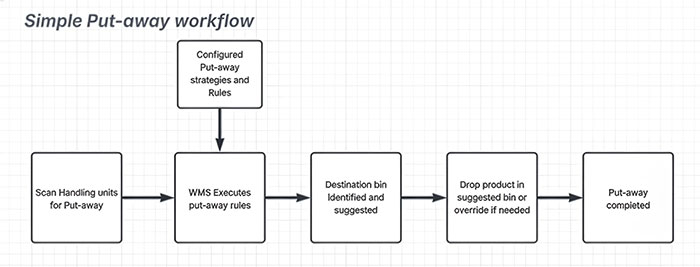
Before (Traditional WMS)
|
Input |
Decision Engine |
Output |
|
SKU + Outbound Attributes |
Fixed put-away rule: “Find bin with matching Ship-To + Ship Date” |
Store in consolidation bin |
After (AI-Assisted WMS)
|
Input |
Decision Engine |
Output |
|
Historical co-pick + outbound demand + bin utilization |
ML model identifies when consolidation improves efficiency |
Suggest grouping only when beneficial, otherwise suggest best alternative bin |
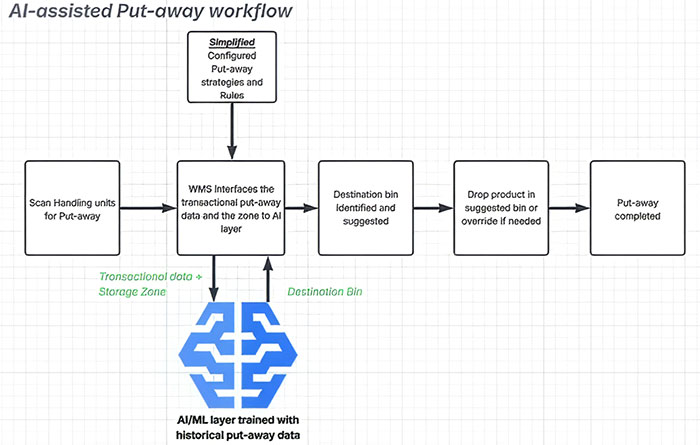
This comparison illustrates a conceptual shift rather than a prescriptive or fully implemented system design.
In this approach, the zone remains fixed and is still determined by the ‘simplified put-away strategies and rules,’ but AI could dynamically select the optimal bin within that zone. This reduces the complexity of the rule needed while allowing real-time optimization. The suggestion of the bin based on grouping logic could be performed by the AI/ML layer thus reducing the static put-away rule configuration complexity.
For instance, AI could avoid a consolidation bin if its aisle is currently congested, something static rules cannot account for.
AI and opportunistic cross-docking
Most WMS products today support opportunistic cross-docking, which is the process where, during inbound put-away, if there is an outbound order waiting for the same product, the system will bypass storage and send the product directly to the outbound staging lane.
This is efficient because:
- The warehouse avoids storing the product and then picking it again.
- It reduces touches, reduces travel, and removes a replenishment cycle.
However, setting this up in a WMS requires a lot of configuration, such as:
- Matching rules between inbound and outbound
- Time horizon settings (e.g., look for outbound demand within X hours)
- Allocation and release timing controls
- Exception scenarios when demand changes
- Custom logic to avoid over-staging or congestion
All of this must be modeled, tested, and maintained. And once implemented, if warehouse conditions change, all of these configurations must be reviewed again.
How AI might improve this
With AI and ML, the system could potentially learn from the warehouse’s historical behavior:
- AI could see when inbound inventory was immediately shipped
- AI could see when cross-docking reduced handling effort
- AI could also learn when cross-docking caused problems, such as:
- Lane congestion
- Bottlenecks at docks
- Too many open outbound orders being staged too early
- Picking delays from blocked staging lanes
So instead of pre-configuring all the logic, AI could potentially learn to identify the behavioral pattern:
“When inbound supply arrives and matching outbound demand exists, cross-dock only when it improves the flow under current warehouse conditions.”
This is different from static configuration, where cross-dock triggers every time demand exists, even if the warehouse is busy or lanes are full.
Cautions and practical considerations
While the idea of simplifying put-away rules using AI is strong, there are a few practical points to consider:
- AI needs historical warehouse behavior data to learn.
If a warehouse is new and does not have enough inbound/outbound movement history, we still need to start with traditional put-away rules first. As the warehouse operates and data builds up, AI can slowly take over more of the bin decision logic.
- Operator predictability is important.
Warehouse operators develop a sense of where products are stored. If bin locations change too often without a pattern, it can slow down operations. So AI should work within defined zones and boundaries, and not move products randomly across the warehouse.
- AI does not replace rules completely. Rules are still required to define:
- Storage zones
- Safety and handling restrictions
- Temperature/hazard constraints
- Large structural layout decisions
AI should only make the bin-level decision inside the allowed space.
- Performance must be evaluated carefully, as put-away transactional data is transmitted to the AI/ML layer and a destination bin is identified in real time, while a warehouse operator on the floor—operating a forklift or pallet jack—is actively waiting for the bin location from the WMS.
- AI suggestions need monitoring.
At least in the beginning, warehouse teams may want to review or spot-check AI-driven placements until confidence grows.
So the practical model is hybrid, where:
- Rules define the zone.
AI selects the best bin inside the zone.
This keeps the system predictable, safe, and operator-friendly, while still reducing the complexity and maintenance effort of detailed put-away rule configuration.
Conclusion
The complexity of put-away rules depends largely on operational requirements. When requirements are simple, static configuration may be sufficient and effective, eliminating the need for any AI-assisted put-away logic. It is only when put-away requirements become complex, an AI layer has the potential to add value.
AI does not eliminate put-away logic; rather, it changes where that logic resides. Instead of handling increasingly complex decision logic into configuration tables, AI allows warehouse behavioral patterns to inform real-time bin placement decisions. In this model, put-away rules become lighter and easier to maintain, while AI could handle the heavier optimization. Over time, as historical data grows, such a model could improve and adapt in ways static rules cannot. This evolution may become feasible over time and represents a practical, incremental step toward AI-assisted put-away in WMS.
About the author:
Sreekumar Somasundaram is a senior supply chain technical program manager at AWS, specializing in warehouse and transportation management systems implementation. With over 18 years of experience, he has been involved in developing and implementing logistics technology solutions across complex business environments. A mechanical engineering graduate with multiple professional certifications including Project Management Professional (PMP), Java and Oracle Programming, Transportation Management, and Supply Chain certifications from MITx, he brings a unique combination of technical expertise and business acumen to his role. His extensive background encompasses logistics solutions architecture, business analysis, and software development for warehouse and transportation systems. Throughout his career, he has successfully led WMS and TMS implementations for multiple Fortune 500 companies.
SC
MR


More Warehouse Automation
- DHL Supply Chain bets on data foundations, robotics, and agentic AI to drive growth
- How industrial real estate decisions are shaping supply chain performance
- Your supply chain automation should trade like a hedge fund
- Why trust, flexibility, and execution now matter more than speed
- Modex 2026: Now & next
- More Warehouse Automation
What's Related in Warehouse Automation
 Explore
Topics
Procurement & Sourcing News
- When component verification becomes operational
- Caught between a rock and a hard place: Mapping your supply chain
- What options do you really have? Shaping the supply chain resilience funnel
- Nexus suppliers: Hidden anchors of resilience in decentralized supply chains
- Lead time economics: What semiconductor supply chains reveal about strategic planning
- Risk sharing is the new advantage in capital project delivery
- More Procurement & Sourcing
Latest Procurement & Sourcing Resources

Subscribe

Supply Chain Management Review delivers the best industry content.

Editors’ Picks



